 Sunny Khurma
Cheif Editor
Sunny Khurma
Cheif Editor
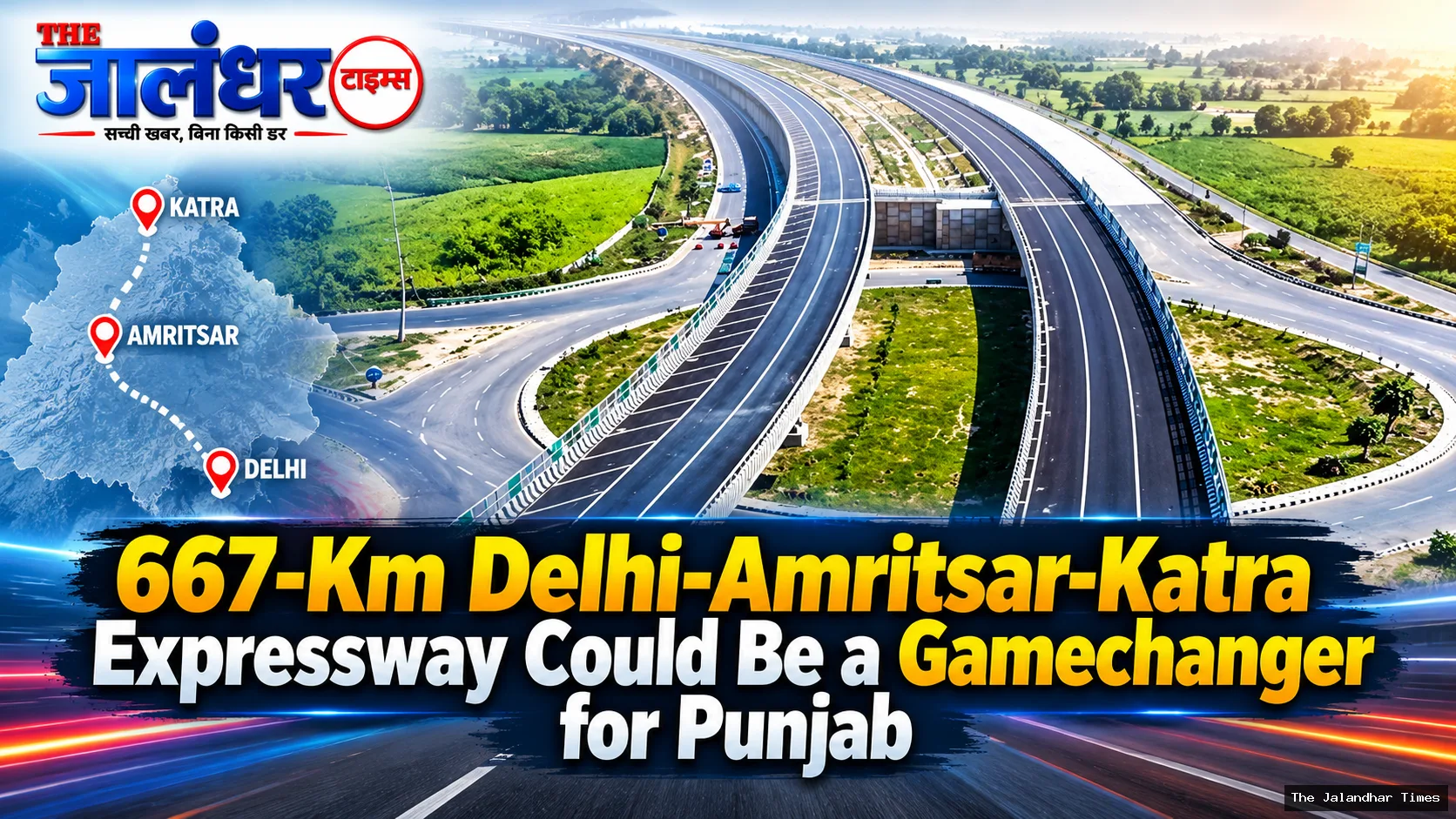
Punjab, October 3, 2026: The Delhi–Amritsar–Katra Expressway is emerging as one of northern India’s most important road infrastructure projects, promising faster connectivity for Punjab while creating new opportunities for trade, tourism, pilgrimage and logistics.
The 667-km access-controlled corridor will connect the Delhi region with Punjab before continuing towards Jammu and Katra. Once fully operational, the expressway is expected to reduce the Delhi–Amritsar journey from around eight hours to approximately four hours, while travel between Delhi and Katra could come down from nearly 14 hours to about six hours.
For Punjab, the project is particularly significant because its route and connecting spurs will improve access to several major economic and religious centres.
The corridor will provide improved connectivity towards Sangrur, Ludhiana, Jalandhar, Kapurthala, Amritsar and Gurdaspur, while also strengthening links with important religious destinations including Sultanpur Lodhi, Goindwal Sahib, Khadoor Sahib and Tarn Taran.
Improved road access to Amritsar will also make travel towards Sri Harmandir Sahib easier for visitors arriving from Delhi and other parts of northern India.
Beyond passenger travel, one of the biggest expected benefits is for Punjab’s economy.
A high-speed access-controlled corridor can reduce journey times for trucks carrying agricultural produce, industrial goods and other freight. Faster movement between Punjab, Delhi-NCR and Jammu and Kashmir could lower transportation delays and improve access to major markets.
Industrial centres around Ludhiana and Jalandhar are also expected to benefit from better freight connectivity.
Punjab’s manufacturing sector—including bicycles, auto components, hand tools, sports goods, textiles and other industries—relies heavily on road transport for movement of raw materials and finished products.
Reduced travel time and predictable highway movement can make logistics more efficient for these businesses.
The expressway could also have a significant impact on tourism.
Travellers heading towards Amritsar, important Sikh religious centres and ultimately Jammu and Katra will have a faster alternative to existing highway routes once the entire corridor becomes operational.
A key feature of the project is that it is being developed as an access-controlled greenfield expressway, meaning entry and exit will be permitted only at designated interchanges rather than through unrestricted roadside access.
This design is intended to allow faster and safer long-distance movement while reducing interference from local traffic.
Progress, however, has not been uniform across the entire project.
A major section in Haryana has already been inaugurated. In July 2026, nearly 158 km covering Packages 1 to 5 was dedicated to the nation, marking an important step towards completing the full corridor.
Another 30.9-km section of the expressway in Punjab was also inaugurated in July, providing additional progress on the Punjab portion of the project.
Several other Punjab stretches are still being completed.
Construction progress has faced delays on some packages, and balance works on certain stretches have had to be tendered again. One such tender covers the section between the Ludhiana–Malerkotla road near Bhogiwal and the Ludhiana–Moga road near Mullanpur Dakha.
The Jalandhar side of the corridor is also important because different sections connect the Ludhiana–Moga route with the Jalandhar–Moga and Jalandhar–Kapurthala road network.
Government project-monitoring data earlier showed different levels of construction progress across these Punjab packages, underlining why the entire corridor has not yet become operational as one continuous expressway.
Quality monitoring has also been strengthened.
The highway authority announced special quality inspections in September for selected under-construction highway projects, including portions of the Delhi–Amritsar–Katra Expressway in Punjab. The inspections are intended to examine construction quality, materials and compliance with prescribed standards before remaining work progresses further.
For motorists, this means the biggest benefits of the project will come gradually rather than immediately.
Although completed sections can improve regional connectivity, travellers should not yet assume that the entire Delhi–Amritsar–Katra Expressway is open end-to-end.
Once all remaining Punjab and Jammu and Kashmir stretches are completed and connected, the project could significantly change the way people travel between Delhi, Punjab and the pilgrimage centres of Jammu and Kashmir.
For Punjab in particular, the expressway has the potential to become more than just a faster road.
By linking major cities, industrial areas, agricultural regions and religious destinations with a high-speed corridor, it could strengthen both passenger mobility and commercial movement across the state.
The real transformation will become visible when the remaining sections are completed and motorists can travel continuously along the full corridor.
For permission to reuse our original reporting or images, contact The Jalandhar Times.