 Sunny Khurma
Cheif Editor
Sunny Khurma
Cheif Editor
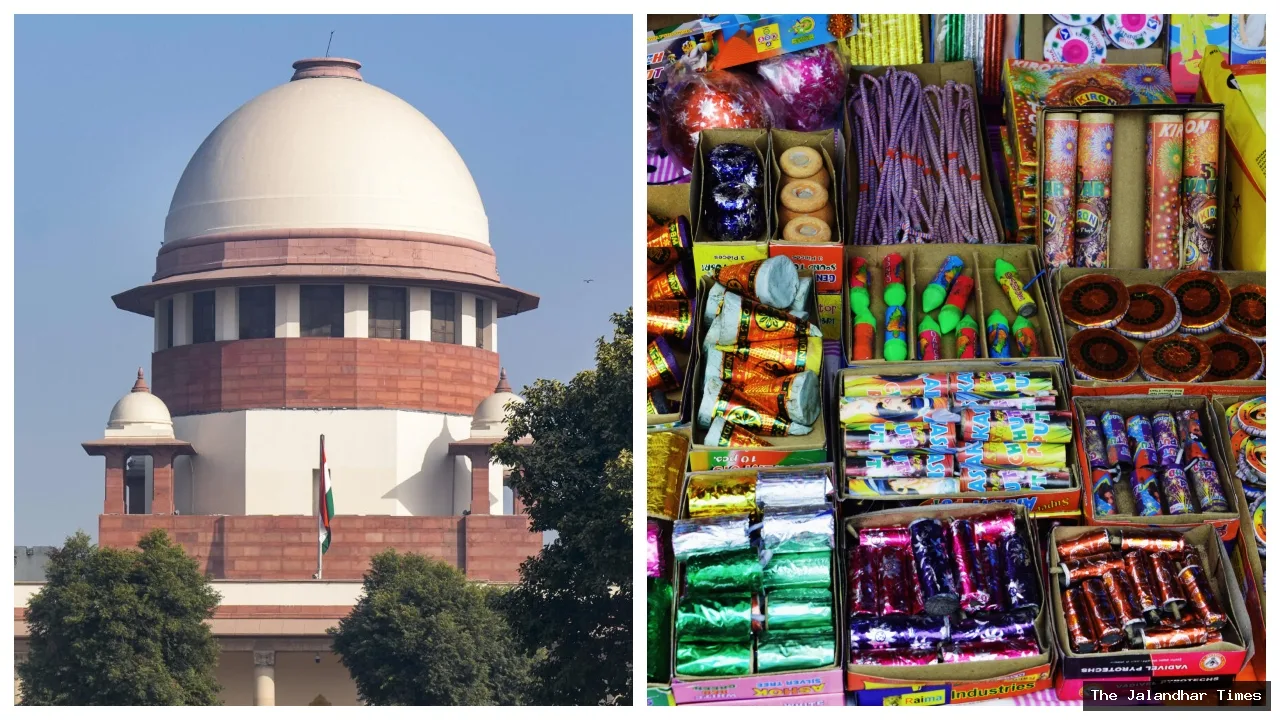
New Delhi, September 30, 2026: Ahead of the festive season, the Supreme Court on Wednesday indicated that it would neither impose a complete ban on firecrackers nor allow people to burst them throughout the day, stressing the need to strike a balance between celebrations, environmental concerns and public health.
A bench comprising Justices M.M. Sundresh and P.B. Varale said that a blanket prohibition could affect public sentiments, while unrestricted use of firecrackers for 24 hours could have a serious impact on children, senior citizens, people with illnesses and others.
The court said a middle path should be adopted under which firecrackers may be permitted only during **specified time periods**. However, the final hours during which crackers will be allowed have not yet been fixed in the present proceedings.
The court was hearing proceedings concerning restrictions on firecrackers and their impact on air pollution. The case traces back to a petition filed in 2015 seeking stronger restrictions because of concerns over deteriorating air quality and the health effects of fireworks, particularly on children and elderly people.
The Supreme Court also permitted certain **specified next-generation joint green crackers, commonly known as laris, subject to prescribed safety and environmental standards.
According to submissions made before the court, expert bodies including CSIR-NEERI, the Petroleum and Explosives Safety Organisation (PESO) and the Central Pollution Control Board (CPCB)** examined the new-generation products. The permitted variants are required to comply with conditions relating to their composition, size, noise levels and intervals between bursts.
The issue of green crackers containing barium, however, has not yet been finally decided.
The Centre and expert agencies have been given time until October 15, 2026, to complete further assessments of the effect of barium-containing green crackers on ambient air quality. The court will consider the scientific findings before taking a final view on those variants.
The court's observations are particularly significant ahead of Diwali, when the use of firecrackers traditionally increases across the country and concerns over air and noise pollution intensify.
Delhi-NCR faces a separate set of proceedings relating specifically to restrictions on firecrackers in the region. The Supreme Court noted that there is some overlap between the two matters and allowed the parties to approach the Chief Justice of India regarding their possible consideration together.
Last year, the Supreme Court had temporarily permitted certified green crackers in Delhi-NCR around Diwali under strict conditions and limited time slots, while conventional firecrackers remained prohibited. Those previous timings should not automatically be treated as the final rules for Diwali 2026, as the regulatory framework for the coming festival season is still being considered.
The latest proceedings therefore make one broad principle clear: the Supreme Court does not favour either extreme — a complete nationwide prohibition or unrestricted use of firecrackers throughout the day.
More clarity on permitted cracker categories, timings and restrictions is expected as the court considers further expert assessments ahead of the festive season.
For permission to reuse our original reporting or images, contact The Jalandhar Times.