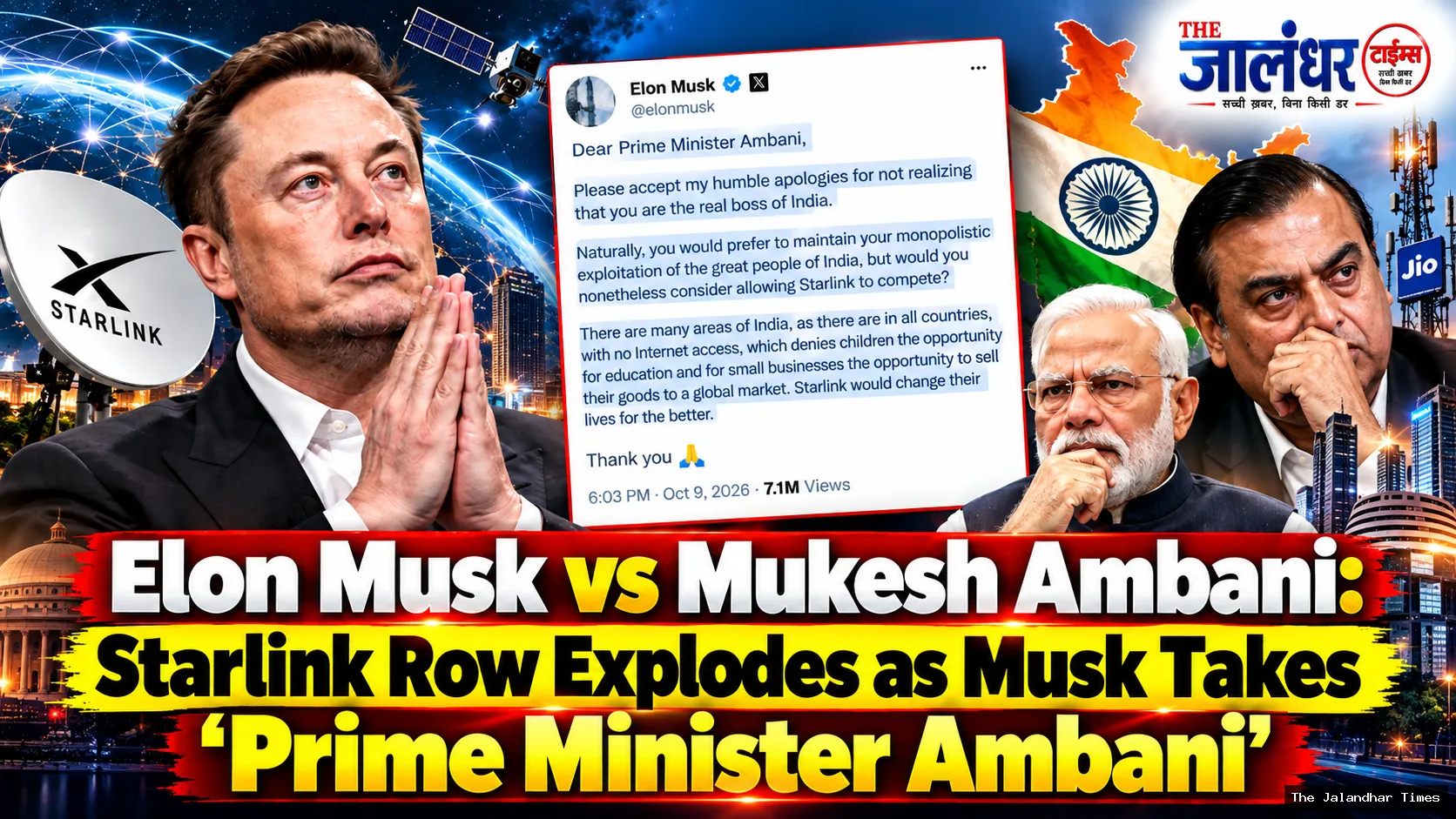
New Delhi, October 9, 2026: The battle over Starlink’s delayed commercial launch in India has taken a sharper turn after SpaceX chief Elon Musk directly targeted Reliance Industries chairman Mukesh Ambani, using the sarcastic phrase “Prime Minister Ambani” while questioning why his satellite internet service has still not been allowed to begin commercial operations in the country.
Musk’s latest intervention follows his earlier allegation that Starlink was being blocked by “certain oligarchs” seeking to protect what he described as their monopolistic position in India. The Indian government has rejected that allegation, maintaining that the regulatory framework for satellite communication companies is fair and applies equally to all operators.
Taking the confrontation further, Musk addressed a message to “Prime Minister Ambani” and questioned whether Starlink would be allowed to compete in India. He argued that greater competition in satellite internet could particularly benefit areas where conventional broadband and mobile connectivity remain weak or unavailable.
Musk also linked the issue to internet access for students and small businesses in remote areas. He argued that satellite broadband could provide educational opportunities to children without reliable connectivity and allow smaller businesses to reach customers in wider national and international markets.
The remarks have transformed what had largely been a regulatory dispute into a high-profile confrontation involving two of the world’s most prominent billionaires. However, Musk has not publicly presented evidence establishing that Ambani or Reliance personally intervened in the regulatory process to prevent Starlink from beginning operations.
The Indian government has pushed back firmly against the monopoly allegation. Union Communications Minister Jyotiraditya Scindia said India does not allow monopoly in any sector and stressed that telecom authorities remain technology-neutral while allowing consumers to choose between competing services.
According to the government, Starlink, Reliance Jio’s satellite venture Jio Satcom and Bharti-backed Eutelsat OneWeb have all obtained satellite communication licences. None can begin full commercial operations until the remaining security conditions are individually fulfilled and the required spectrum is assigned.
Scindia said spectrum would be made available once the government finalises the applicable charging framework, while every satellite operator must separately demonstrate compliance with security requirements before starting services.
This means Starlink’s continuing wait does not amount to a formal rejection of the company’s entry into India. Instead, the government says its commercial launch remains dependent on completion of regulatory, security and spectrum-related requirements.
Musk has questioned why the process has taken so long, saying Starlink operates in more than 165 countries and has spent several years complying with Indian laws and government requirements. His public criticism has brought renewed attention to the length and complexity of India’s satellite-communications approval process.
The dispute has also triggered a political debate in India. Congress leader Rahul Gandhi responded to Musk’s earlier remarks, while BJP leaders and government representatives have defended the regulatory framework and rejected suggestions that spectrum or licences are being allocated in a discriminatory manner.
The commercial stakes are significant. India represents one of the world’s largest potential markets for satellite broadband, particularly in rural, mountainous and underserved areas where laying fibre-optic cables or constructing traditional telecom infrastructure can be costly and difficult.
Starlink uses a large network of low-Earth-orbit satellites to deliver internet connectivity through ground terminals. The technology can provide broadband in locations beyond the effective reach of traditional wired networks, although governments also impose security and monitoring requirements because of the way satellite services operate.
Reliance Jio and Bharti Airtel are already major players in India’s traditional telecom market, while their associated businesses are also preparing for the emerging satellite broadband sector. Starlink’s eventual commercial entry would therefore add another major competitor to the market.
The Indian government’s position remains that competition is welcome but no company will be exempted from national security and regulatory requirements. Officials have maintained that all licensed satellite operators must complete the same process before they can begin serving customers.
For now, Musk’s “Prime Minister Ambani” remark has significantly raised the temperature of the debate, but the central regulatory question remains unchanged: when Starlink completes the remaining requirements, how soon will it be able to switch on its commercial satellite internet services in India?
Until those approvals are completed, the confrontation between Musk’s public allegations and the government’s insistence on equal regulatory treatment is likely to keep Starlink’s India launch under intense scrutiny.
For permission to reuse our original reporting or images, contact The Jalandhar Times.