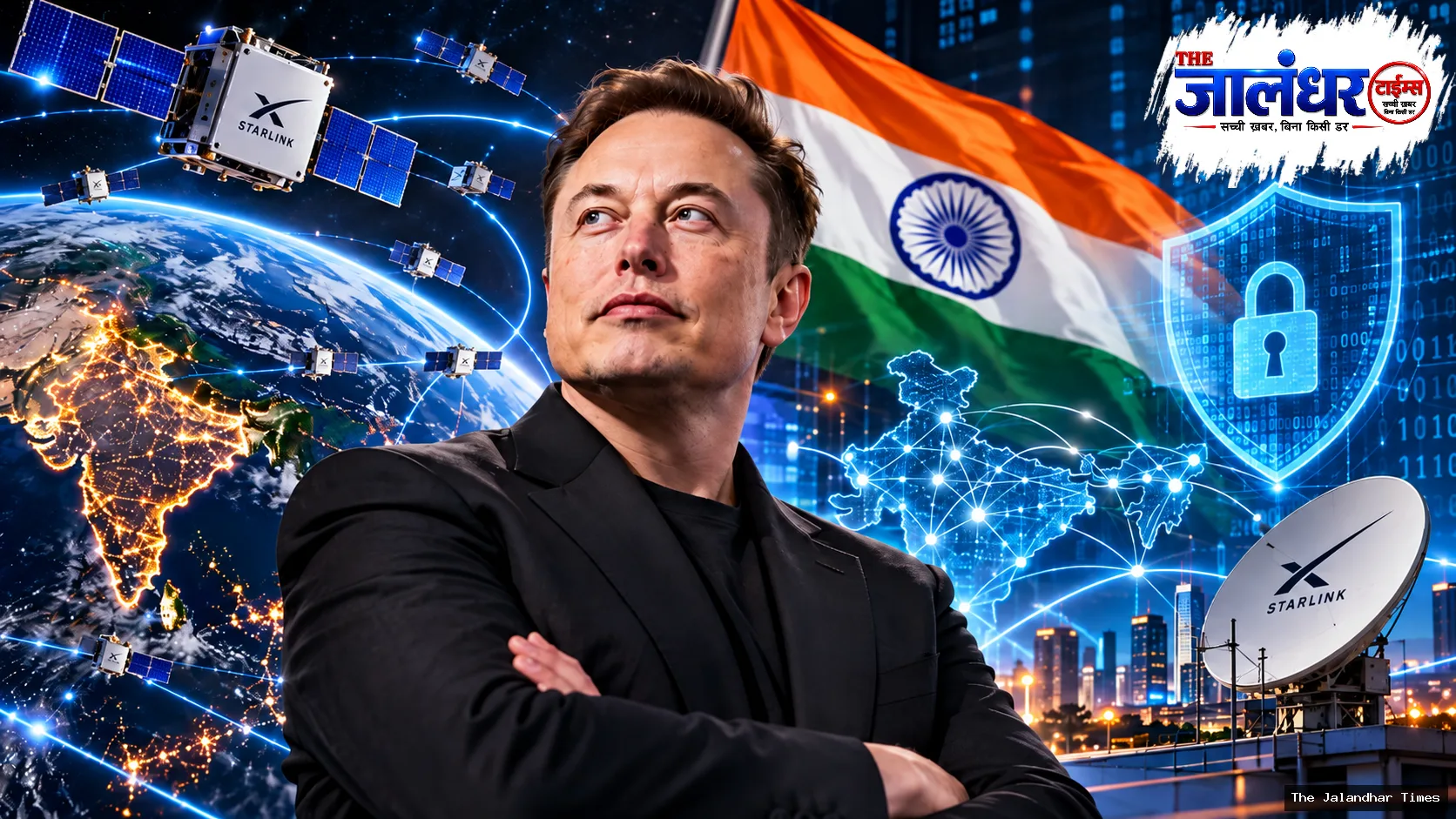

Jalandhar October 10, 2026: India’s satellite internet race is gathering pace as Reliance Jio moves ahead with plans for a massive home-grown satellite network at a time when Elon Musk’s Starlink is still waiting to begin commercial operations in the country.
Jio has outlined a plan involving around 1,600 low-Earth-orbit satellites and 23 ground stations across India, marking one of its most ambitious moves yet beyond traditional mobile and fibre networks.
The proposed system is being developed around the idea of sovereign satellite connectivity, with Jio aiming to build an Indian satellite ecosystem capable of reaching locations where conventional telecom infrastructure remains difficult or expensive to deploy.
The network is intended to extend connectivity to remote villages, islands, border areas and other locations that may not have reliable fibre or mobile coverage. Jio is also looking at applications in maritime connectivity, aviation, enterprise services, government communications, disaster response and potentially direct-to-device services.
The proposed constellation would work alongside Jio’s existing terrestrial telecom network rather than replace it. Ground stations would connect the satellite infrastructure with Jio’s fibre, mobile and data networks, creating an integrated system covering both space and ground communications.
Jio has indicated that it wants a substantial part of the satellite technology chain to be developed and operated within India, including engineering, integration, testing, deployment and network operations.
The company’s satellite ambitions are not entirely new. Reliance had earlier said that Jio was evaluating the development of its own sovereign low-Earth-orbit constellation while simultaneously working with global satellite providers to accelerate availability of satellite services.
What has changed is the scale now being outlined. A network of around 1,600 satellites would place Jio directly into an emerging market currently dominated globally by established satellite operators, with Elon Musk’s Starlink being by far the most visible player.
The timing has also drawn considerable attention because Starlink’s commercial launch in India remains pending despite the company having secured important regulatory authorisations.
Starlink is still required to complete the remaining security-compliance process before moving to the spectrum-assignment stage and ultimately starting commercial services.
The Indian government has maintained that Starlink is not being singled out and that licensed satellite operators are being treated under the same regulatory framework. Authorities have said national security requirements must be satisfied before any operator is permitted to activate commercial services.
The delay has prompted increasingly sharp criticism from Musk, who recently alleged that powerful business interests were attempting to protect their position in India’s telecom market. He later directly targeted Mukesh Ambani in a series of public remarks.
Musk has not publicly produced evidence establishing that Ambani or Reliance personally influenced the regulatory process to stop Starlink. The government has rejected the suggestion that India’s satellite communications framework favours one company over another.
Against that backdrop, Jio’s proposed 1,600-satellite network has added another layer to the growing rivalry surrounding India’s future satellite broadband market.
Jio already has enormous scale on the ground through its mobile and broadband networks. A successful satellite system could allow the company to extend that reach into areas where towers and fibre cables alone cannot provide economical coverage.
Starlink approaches the market from the opposite direction. SpaceX has already deployed a large global constellation and operates satellite broadband services across numerous countries, meaning much of the space infrastructure needed for an Indian service already exists.
The battle is therefore not simply about which company can launch more satellites. It is also about spectrum, security rules, ground infrastructure, pricing, integration with existing networks and the ability to serve remote users at a sustainable cost.
For consumers, competition between satellite operators could eventually create more options for homes and businesses that currently struggle with weak connectivity. Rural education, telemedicine, emergency communications and small businesses are among the areas frequently cited as potential beneficiaries of wider satellite coverage.
Jio’s 1,600-satellite proposal remains a future plan rather than an operational constellation, and deployment would require substantial investment, technical implementation and the necessary regulatory approvals.
Starlink, meanwhile, remains closer to having an existing satellite network available but cannot begin commercial operations in India until the country’s remaining regulatory requirements are completed.
The developments are setting up an unusual technology contest: Mukesh Ambani’s Jio is preparing to build an Indian satellite network from the ground up, while Elon Musk’s already-established Starlink constellation waits for clearance to enter one of the world’s largest telecom markets.
For permission to reuse our original reporting or images, contact The Jalandhar Times.